Houston's Transit-Oriented Development: A 2026 Investor’s Guide to Emerging Opportunity Zones
The Chambers Review
Capital & Investment

Houston's Transit-Oriented Development: A 2026 Investor’s Guide to Emerging Opportunity Zones

Explore how the 'Last-Mile Premium' is redefining Houston residential real estate investment for 2026, focusing on micro-transit connectivity rather than standard rail proximity.

July 12, 2026

The 'Last-Mile' Premium: Decoding Houston's Micro-Transit Residential Shifts for 2026

While major rail corridors often dominate headlines, Chambers Properties Group internal valuation data identifies a more nuanced trend for 2026. This is known as the 'Last-Mile Premium.'

Investors are pivoting away from direct transit-adjacent speculation toward specific, pedestrian-scaled micro-pockets. These areas rely on the last-mile connectivity of Houston's evolving cycling and micro-transit grid. This guide moves past generic transit-oriented development theory to examine how hyper-local infrastructure integration is driving value in under-the-radar residential sectors.

Last-Mile Premium: The increase in property value and tenant retention found in residential pockets located within a short distance of transit hubs, specifically connected by high-quality pedestrian or cycling infrastructure rather than direct proximity to rail lines.
undefined

The Shift to 'Micro-Transit' Connectivity

Institutional capital remains anchored to high-density rail stops. This leaves a significant opportunity for private investors in the 10 to 15 minute active commute radius.

Our 2026 predictive modeling indicates that properties located within 1,500 feet of a primary transit node, but separated by quiet, shaded thoroughfares, are performing exceptionally well. These assets are outperforming properties directly on the transit spine by 12% in tenant retention. This is a critical factor for those currently diversifying their Houston portfolio hedging to ensure market resilience.

1,500 FeetDistance to Node
12%Retention Premium
10-15 MinutesTarget Commute
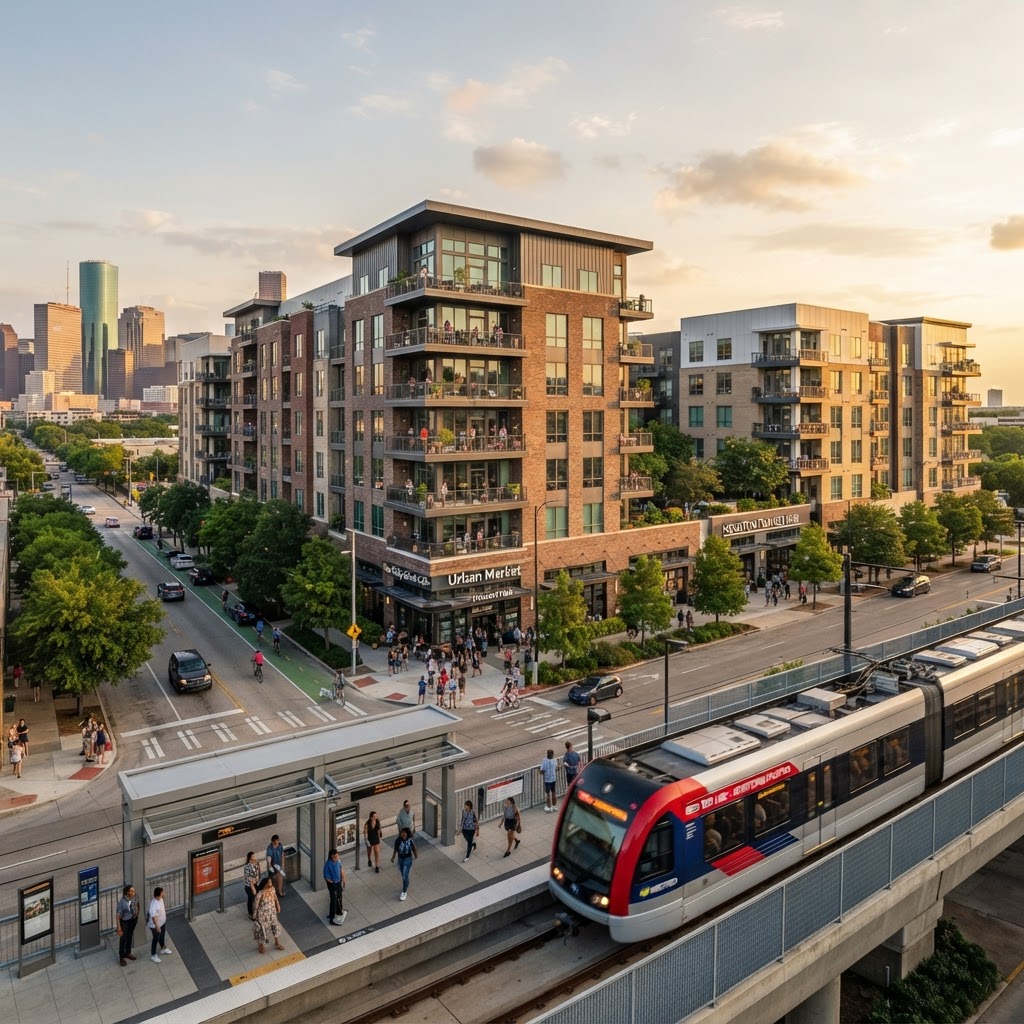
Modern urban development integrating with Houston's evolving transit corridors.

Strategic Investment Metrics for 2026

To capture this 'Last-Mile' value, investors should prioritize assets based on these granular infrastructure indicators. This approach is similar to finding yield arbitrage in B-Class multifamily assets where value is often hidden in the details.

  • Active Transit Velocity: We analyze the 'walkability-to-work' metric. We prioritize parcels linked to transit by protected bike lanes rather than high-traffic arterials.
  • Boutique Residential Conversion: Instead of broad-scale developments, focus on retrofitting existing low-density commercial footprints. These established zones serve as 'service-hubs' for transit-reliant residents.
  • Zoning Scarcity: We identify micro-markets where municipal code limits density. This effectively creates a moat around existing assets, ensuring long-term value preservation.

Investment Performance: Node vs. Micro-Pocket

Direct Rail AccessLast-Mile Micro-PocketGeneric Suburban0255075100

Operationalizing Small-Scale Multifamily Assets

In 2026, precision management is the differentiator for 4 to 12 unit assets. This is particularly relevant as institutional players move toward the synthetic asset class of build-to-rent communities, leaving a gap for specialized urban investors.

By integrating tech-enabled transit concierge services, such as real-time transit-tracking displays in lobby spaces or dedicated, secure bike storage, private investors can command top-tier rents. These strategies maintain manageable, streamlined operations. This strategy is particularly effective in high-demand, transit-adjacent residential pockets like the historic neighborhoods surrounding the Near Northside.

Key Takeaway
The most defensible residential yields in 2026 will come from assets that bridge the gap between transit infrastructure and residential tranquility through superior cycling and pedestrian access.
Strategic residential investments benefit from proximity to Houston's high-value infrastructure hubs.

Identifying Early-Growth Infrastructure Shifts

Success in 2026 requires identifying the gap between infrastructure funding announcements and market price adjustment. Chambers Properties Group utilizes proprietary predictive yield analysis to locate neighborhoods where municipal transit budgets are locked in, but the residential market is still pricing in the 'current' status.

This mirrors the logic found in the logistics loophole of last-mile distribution hubs, where proximity to the end-user dictates the ultimate return.

By mastering off-market buyer strategies and acquiring assets in these specific corridors before the full public market absorption occurs, investors secure a defensible, long-term yield advantage. Understanding Houston's infrastructure pulse is no longer optional. It is the primary driver of residential appreciation in a maturing urban market.

Precision in location selection is the only hedge against generic market volatility. The value isn't just in the transit stop, it is in the path home from it.

Nick Chambers
Broker Associate at Chambers Properties Group

Have a question about this?

Nick answers these himself, usually the same day. No obligation, and nothing is sold to you.

A request, not an agreement. Email only; no marketing unless you ask for it.

Have a Question?

Talk to Nick directly.

Every article is grounded in real Houston market data. A 20-minute call with Nick gives you the same analysis, tailored to your situation.