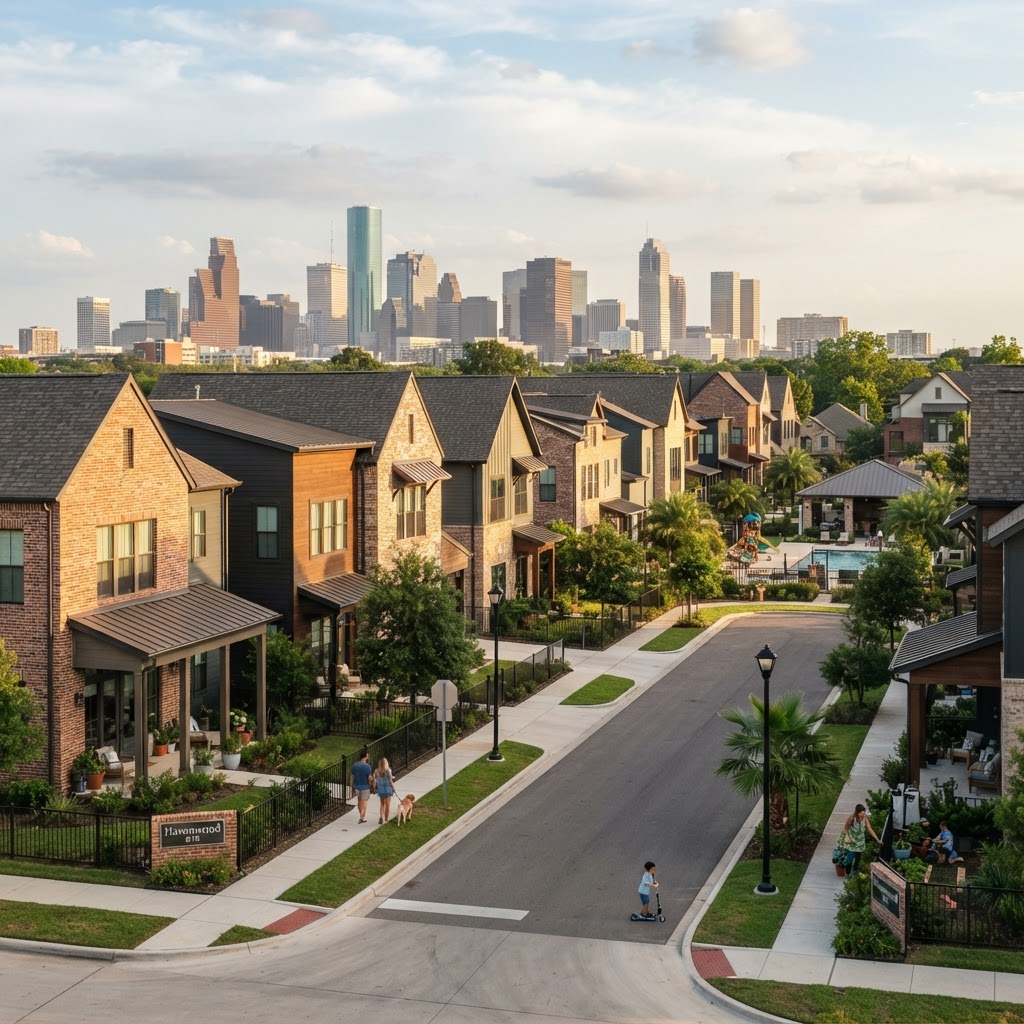
The emergence of institutional-grade build-to-rent (BTR) communities in Houston represents a profound shift in the city’s residential investment landscape. Rather than viewing the current housing supply simply as a collection of individual units, sophisticated investors are now treating these master-planned horizontal communities as a synthetic asset class.
This model, which combines the operational efficiencies of institutional multi-family housing with the durable tenant demand characteristic of single-family living, has become a core strategy for deploying capital. As the city matures into a global tech and energy hub, these developments serve as a critical bridge for a professional workforce seeking high-end finishes without the immediate burden of homeownership. This evolution is central to current Houston Portfolio Hedging: A 2026 Strategy for Market Resilience.
The Infrastructure of Synthetic Asset Classes
The Houston BTR investment landscape is not just about real estate. It is about infrastructure-level efficiency. By aggregating hundreds of detached homes under a single professional management umbrella, firms can drive economies of scale that are impossible to achieve in scattered, retail-bought rental portfolios.
This concentration allows for advanced data-driven maintenance scheduling and the implementation of institutional-grade smart-home ecosystems. When evaluating a Houston BTR investment, the primary focus is on the long-term internal rate of return. This is heavily influenced by lower turnover and decreased maintenance expenditures relative to traditional Class-A vertical luxury assets, a trend further detailed in Houston’s Infrastructure Pulse: 2026 Real Estate Impact Report.
Modern horizontal BTR communities offer the privacy of a backyard with the professional management of a luxury high-rise.
Operational Efficiency and NOI Optimization
The transition toward professionalized rental communities across corridors like the Grand Parkway and the northwest energy sector is driven by a clear mandate. Developers must provide the space of a suburban home with the high-touch service of an apartment complex. For professionals arriving in the city, this product type is increasingly highlighted in The Ultimate Houston Relocation Guide: A Stress-Free 2026 Move.
From an investment perspective, this removes the volatility of individual property maintenance and replaces it with a streamlined, NOI-focused operational model. This is the new baseline for institutional real estate in Houston, where the asset is defined by its ability to perform across economic cycles rather than short-term appreciation spikes. For those monitoring energy-sector growth, these assets are becoming the primary anchors in The Resilient Corridor: Why Houston’s Energy-Transition Infrastructure is the New Anchor for Institutional Returns.
Tenant Retention and Market Resilience
Tenant behavior within these communities further validates the model. We are seeing higher retention rates among families and professionals compared to the high-churn environment of urban centers like Montrose or the Medical Center. As these BTR developments proliferate, the competitive edge for investors will come from their ability to integrate utility-resilience features and high-speed digital infrastructure.
Meeting the demands of the modern remote-hybrid workforce requires more than just square footage. Investors are now exploring advanced integrations, such as those found in The Battery-Storage Arbitrage: Scaling Houston Residential Portfolios with Off-Grid Autonomy, to ensure year-round reliability. The institutional shift is not merely additive. It is disruptive, forcing traditional landlords to elevate their own management standards to compete with the service levels inherent in BTR.
The shift toward institutional management brings commercial-grade rigor to the suburban residential market.
Case Study: CPG Data-Driven Acquisition Model
At Chambers Properties Group, we recently advised an institutional client on a 150-unit horizontal development in the Grand Parkway corridor. By leveraging our proprietary predictive analytics, which you can explore further in our report on Predictive Yield Analysis: Leveraging AI to Forecast Houston Commercial Real Estate Performance in 2026, we identified a 12% vacancy reduction compared to surrounding retail-managed portfolios.
This delta was achieved through a combination of tech-forward amenity staging and optimized utility-management contracts. Our team emphasizes that the rental yield premium is captured by offering this unique product type in high-growth zones. By focusing on asset-specific metrics like net operating income per square foot, institutional real estate Houston investors can successfully navigate the current interest rate environment.
For those looking to diversify beyond traditional structures, this strategy offers a compelling alternative to The Houston Yield Arbitrage: Capitalizing on B-Class Multifamily Assets in 2026. As we look toward 2026, the synergy between technology-forward property management and resilient physical design will define the next tier of institutional returns.
By Nick Chambers, Broker Associate, Chambers Properties Group · Realty of America. If you are ready to explore high-yield institutional housing opportunities or want to discuss your portfolio strategy, schedule a consultation with our investment advisory team to review our proprietary Houston market data.