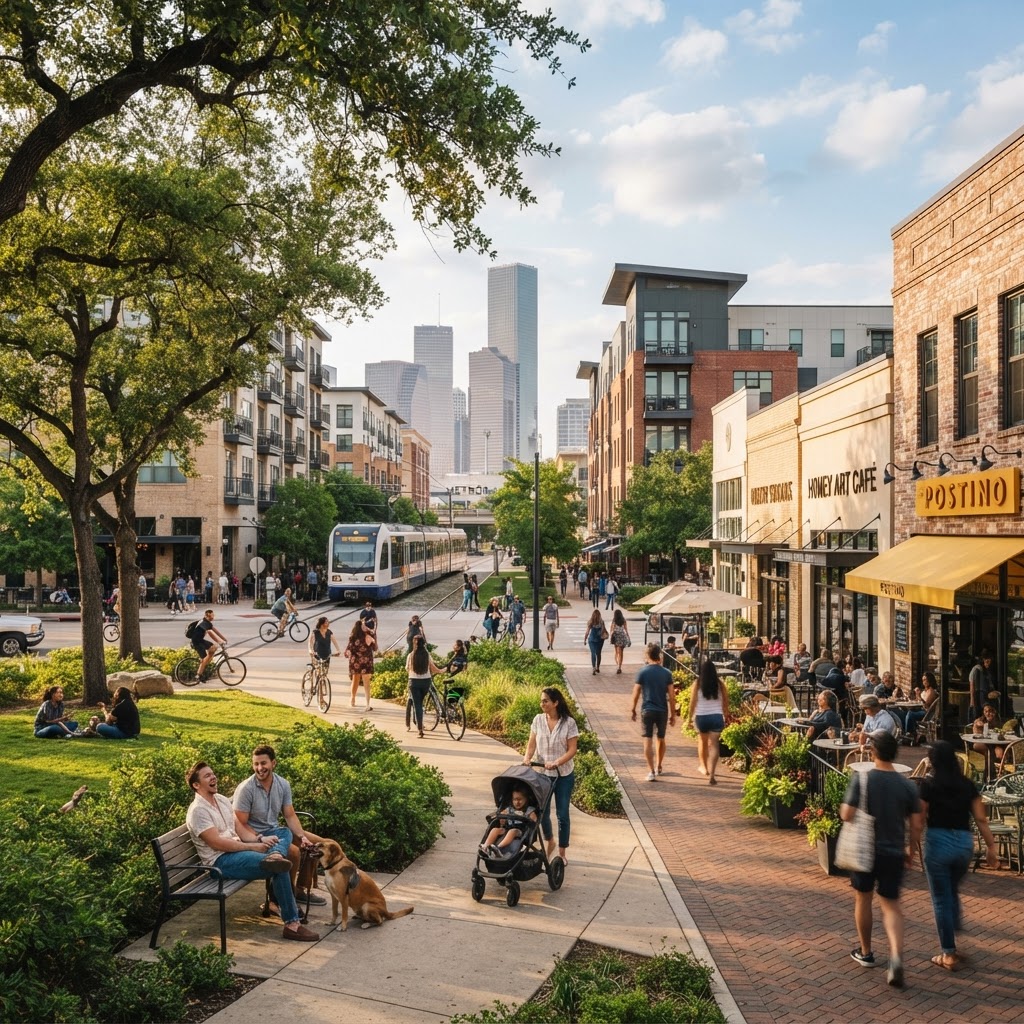
The sprawling, vehicle centric era of Houston real estate, the age of the two hour commute and the endless suburban ring, is undergoing a quiet but seismic correction. As we settle into 2026, the data from our local markets suggests that the post pandemic craving for isolation has been replaced by a sophisticated hunger for accessibility, density, and authentic community engagement.
We are witnessing a definitive suburban to urban shift, where high net worth professionals and astute investors are pivoting away from the far flung fringes and recalibrating their focus toward the city’s historic, high density core.
This movement is not merely a preference for shorter commutes. It is a fundamental reassessment of long term asset value. As property markets mature, the neighborhoods that offer a dense, interconnected lifestyle are consistently outperforming the low density sectors in both retention and appreciation. For the discerning buyer, the opportunity lies in understanding why Houston, a city once defined by its lack of formal zoning, is now becoming one of the most compelling laboratories for urban revitalization in the United States.
Explore Houston neighborhoods to see how these dynamics are shifting the landscape in real time.
The Re-Urbanization Trend: Density as the New Luxury
For decades, the standard for Houston luxury was defined by square footage and privacy. Today, the definition has evolved. The modern professional, particularly the executive demographic, increasingly values time sovereignty, the ability to navigate work, leisure, and social responsibilities within a compressed geographic radius.
This shift is fueling a migration back into established corridors like The Heights, Montrose, and West University Place, where buyers are focusing on walkable micro markets that offer immediate access to amenities.
Current market data illustrates this transition clearly. In 2026, homes within these inner loop pockets are seeing a median sales price increase of roughly 4.2% year over year, significantly outpacing the broader Harris County average. Furthermore, the days on market for premium properties in these zones has tightened significantly. Investors are noting this trend. When inventory is constrained and demand is high, the velocity of value remains in the urban core.
Vertical density and modern architecture are defining the new Houston urban core.
Zoning and Density Evolution: Houston’s Architectural Pivot
Houston’s unique regulatory environment has long been a subject of curiosity. However, by 2026, municipal initiatives focused on smart density have fundamentally altered the aesthetic and utility of our neighborhoods. Areas like Oak Forest and Montrose have become epicenters for a new type of residential development: the boutique mid rise and the modernized historic bungalow.
The move toward higher density is effectively maximizing the utility of land that was previously underutilized. We are seeing developers lean into vertical zoning and missing middle residential expansion to meet demand. In neighborhoods such as The Heights, where early 20th century aesthetics are protected by historic mandates, we see a fascinating tension between preservation and modernization.
For the investor, this means that simple land value is no longer the sole driver of ROI. Instead, the valuation of a property is increasingly tied to its ability to support gentle density without sacrificing the character of the streetscape.
The Walkability Premium: Quantifying the 15-Minute Lifestyle
The 15 minute city concept, the idea that all essential services should be reachable within a 15 minute walk or bike ride, has transitioned from an urban planning buzzword to a primary valuation metric in the Houston luxury market. Data from the current quarter shows a growing walkability dividend in neighborhoods like River Oaks and West University Place.