Navigating Houston's Zoning and Density: A Duplex Conversion Strategy for 2026
While traditional small multifamily investing in Houston often centers on existing inventory, the smartest capital in 2026 is pivoting toward tactical densification as part of a broader Houston portfolio hedging strategy. As Houston’s land use regulations evolve, investors are increasingly looking at high equity neighborhoods like The Heights and Montrose not just for move in ready units, but for conversion potential.
By identifying underutilized single family lots and navigating current zoning frameworks, savvy investors are creating fourplex equivalent yields on land once reserved for single homes. This approach requires mastering Houston’s off market market to find properties before they reach the general public.
The Density Arbitrage: Conversion vs. Acquisition
Acquiring a turnkey fourplex at a 7.5 percent cap rate is increasingly difficult in a tightened inventory market, mirroring the competition found in B Class multifamily assets. Instead, the current Chambers Properties Group methodology suggests a focus on the density arbitrage.
- Lot Utilization: Identify R 2 or R 3 zoned lots where existing structures can be legally converted or expanded into multifamily units.
- Regulatory Runway: Leveraging Houston’s Chapter 42 modifications allows for creative site planning that maximizes buildable square footage, a concept central to understanding Houston’s infrastructure pulse.
- Neighborhood Premiums: Targeting forever starter areas like West University Place, where the demand for boutique, multi unit housing is high but supply remains strictly controlled.
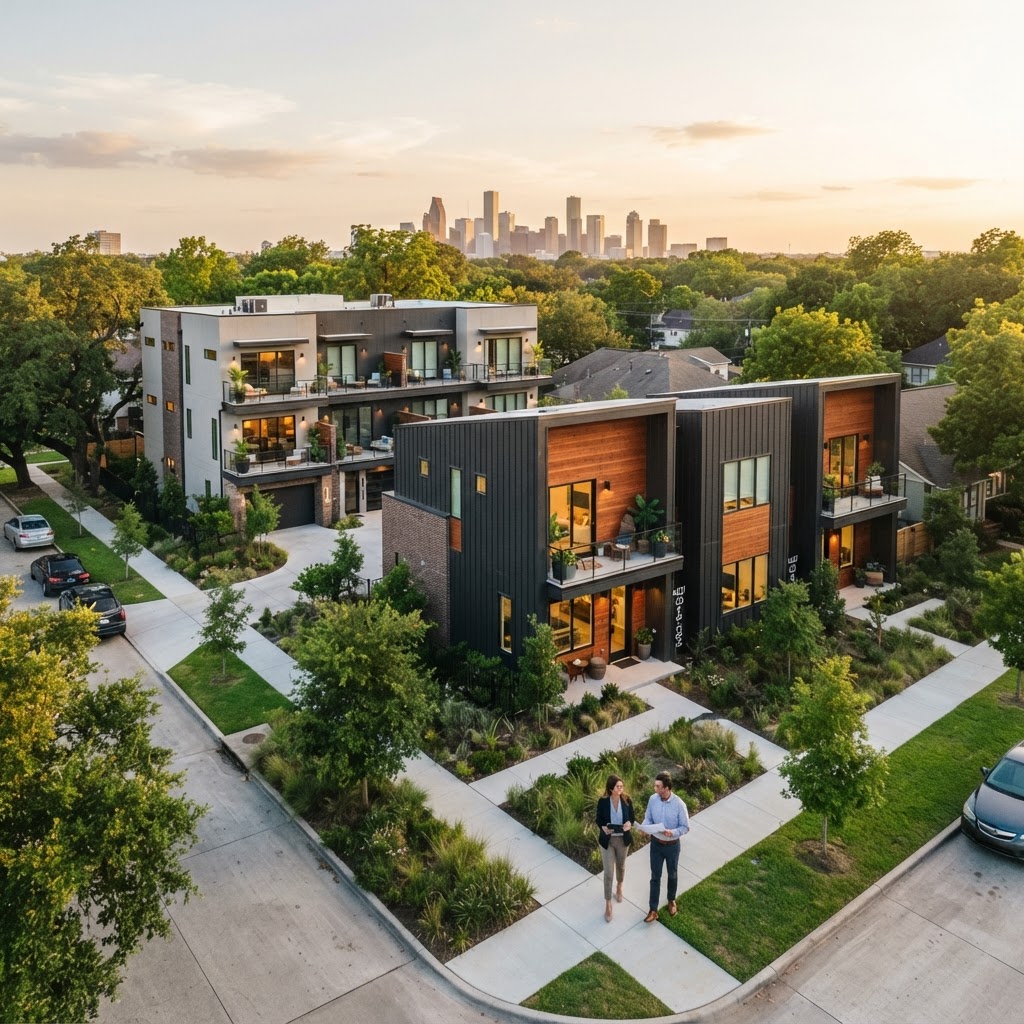
Modern urban development in Houston focuses on maximizing vertical space and lot utility to meet the growing demand for inner loop housing.
Strategic Underwriting for 2026
When evaluating these conversion plays, standard rent rolls are insufficient. We recommend an underwriting framework that accounts for the density premium and utilizes predictive yield analysis to forecast long term performance.
- Permitting Costs: Factor in a 15 to 20 percent contingency for city regulated utility upgrades and site drainage requirements.
- Financing Velocity: Move beyond conventional loans. Utilizing bridge to perm financing allows investors to stabilize the asset during the conversion phase before refinancing into synthetic asset class structures or long term DSCR vehicles.
- Occupancy Modeling: Unlike generic multifamily, conversions in high demand submarkets like Bellaire or River Oaks command a premium from tenants who are moving to Houston for remote work flexibility, allowing for higher per door revenue than traditional models.
By shifting your lens from simple buy and hold acquisition to density driven development, you secure assets with long term, inflation resistant value.
High equity neighborhoods like Montrose offer the perfect canvas for tactical densification through sophisticated conversion strategies.
For those looking to scale more rapidly, these strategies can be integrated into fractional ownership models to spread risk across multiple conversion projects. By shifting your focus toward density driven development, you move beyond the competitive bidding wars of the general market and secure assets with long term value.
***
By Nick Chambers
Broker Associate at Chambers Properties Group in Houston