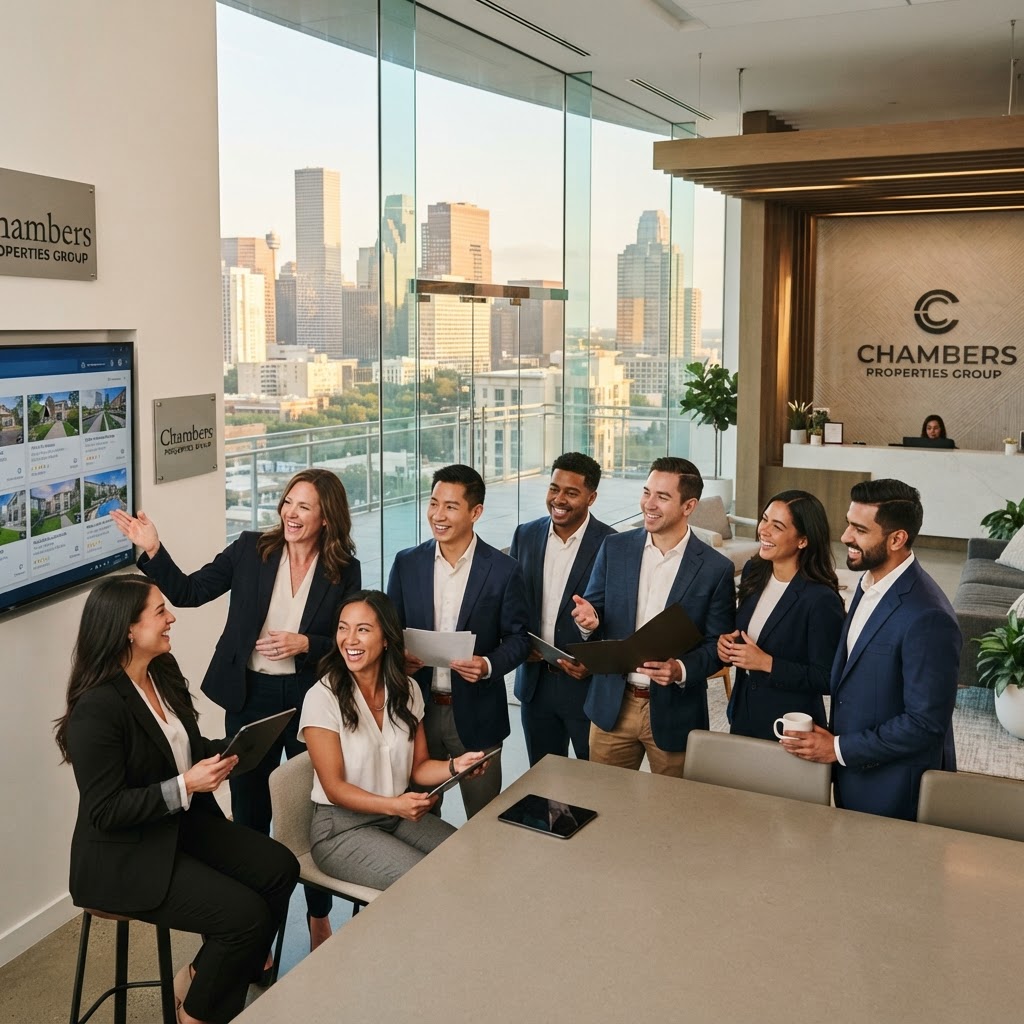
The 2026 Architectural Audit: Why Elite Houston Producers are Re-engineering Their Business Model.
For the past decade, the Houston real estate industry operated under a singular, flawed assumption: that agent success was a direct function of transactional volume.
We have all witnessed the frantic race to close, the endless cycle of open houses, and the inevitable burnout that comes from treating a career as a series of disconnected commissions. However, as we head into late 2026, the most successful agents in the Inner Loop are pivoting.
They are not merely switching brokers. They are conducting a comprehensive, data-driven audit of their business architecture. At Chambers Properties Group (CPG), we are analyzing why high-performing agents are choosing to abandon the legacy high-turnover model in favor of the Advisor-Entrepreneur framework.
Beyond the Transactional Machine: The Shift to Advisory Integration.
The traditional brokerage model thrives on keeping agents in a perpetual state of transaction-based dependency. In this model, you are only as good as your last closing.
But for agents working in sophisticated enclaves like River Oaks, Tanglewood, or West University, the market has matured beyond basic contract facilitation. Today’s high-net-worth buyers require a synthesis of financial forecasting, long-term asset management, and technical due diligence. Many are looking for an intelligent brokerage blueprint to guide this transition.
When you view your practice as an administrative role, you are vulnerable to AI-driven tools that can perform basic logistics. When you shift to an advisor role, you become a permanent fixture in your client’s wealth strategy. — Nick Chambers
The 2026 Auditor-Agent is replacing the "door-opener" mentality with a deep understanding of residential asset management and tax-efficient portfolio growth. This is a primary driver in attracting high-performing Houston agents who demand more than legacy support.
The shift toward the Advisor-Entrepreneur model requires a robust, technical infrastructure to support sophisticated client needs in 2026.
Rebuilding Infrastructure for Maximum Scalability.
Many top producers have hit a revenue ceiling because they are over-leveraged on manual administration. If you are dedicating a significant portion of your day to CRM maintenance, document formatting, or contract scheduling, you are essentially paying for your own inefficiency.
At CPG, we have moved beyond standard brokerage support by deploying a proprietary operational stack that automates the friction of the transaction. By offloading these mechanical tasks to tech-centric firms, the Advisor-Entrepreneur is free to focus on what actually moves the needle: complex negotiation, strategic positioning, and hyper-local market intelligence.
We don't just provide desk space. We provide the operational architecture that allows you to double your output without increasing your stress. For those seeking to leverage the AI advantage, this transition is essential. Furthermore, the fractional brokerage model offers a way to scale without the traditional overhead that anchors legacy practices.
The Equity-Based Partnership vs. The Commission Split.
The most profound shift occurring in the Houston market right now is the departure from pure commission-split dependency. Legacy firms often incentivize volume for the sake of the house, which can conflict with the agent’s goal of building a lasting business.
The alternative model, which we champion at CPG, treats the agent’s practice as a collaborative firm. By moving to an equity-aligned environment, you gain the autonomy to prioritize long-term retention over immediate, transactional churn. This is why many are exploring equity-model brokerages to secure their financial future.
We are seeing a measurable migration of top-tier talent who have realized the value of collaborative equity cultures over high-split brokerages that offer no long-term stake. If your goal is to build a practice that continues to provide value well into the 2030s, your structure must reflect that longevity.
Houston's top producers are moving away from transactional churn in favor of equity-based partnerships.
Transitioning to the 2026 Advisor-Entrepreneur Model.
Success in the upcoming year will not be defined by how many homes you sell, but by the depth of your market position and the robustness of your technical stack. The gap between traditional agents and the new class of Advisor-Entrepreneurs is widening every month.
The question for every top producer in Houston is not "where should I move my license?" but "how do I audit my current practice to ensure it survives the AI-driven market transition"?
Oftentimes, the barrier to this growth is the mentorship gap found in traditional environments. At Chambers Properties Group, we provide the systemic support required to facilitate this shift. We are looking for agents who are ready to discard the old playbook and embrace a future defined by precision, strategy, and long-term asset focus.
By Nick Chambers, Broker Associate, Chambers Properties Group · Realty of America.
Ready to audit your practice? Reach out to CPG today to discuss our 2026 transition framework.