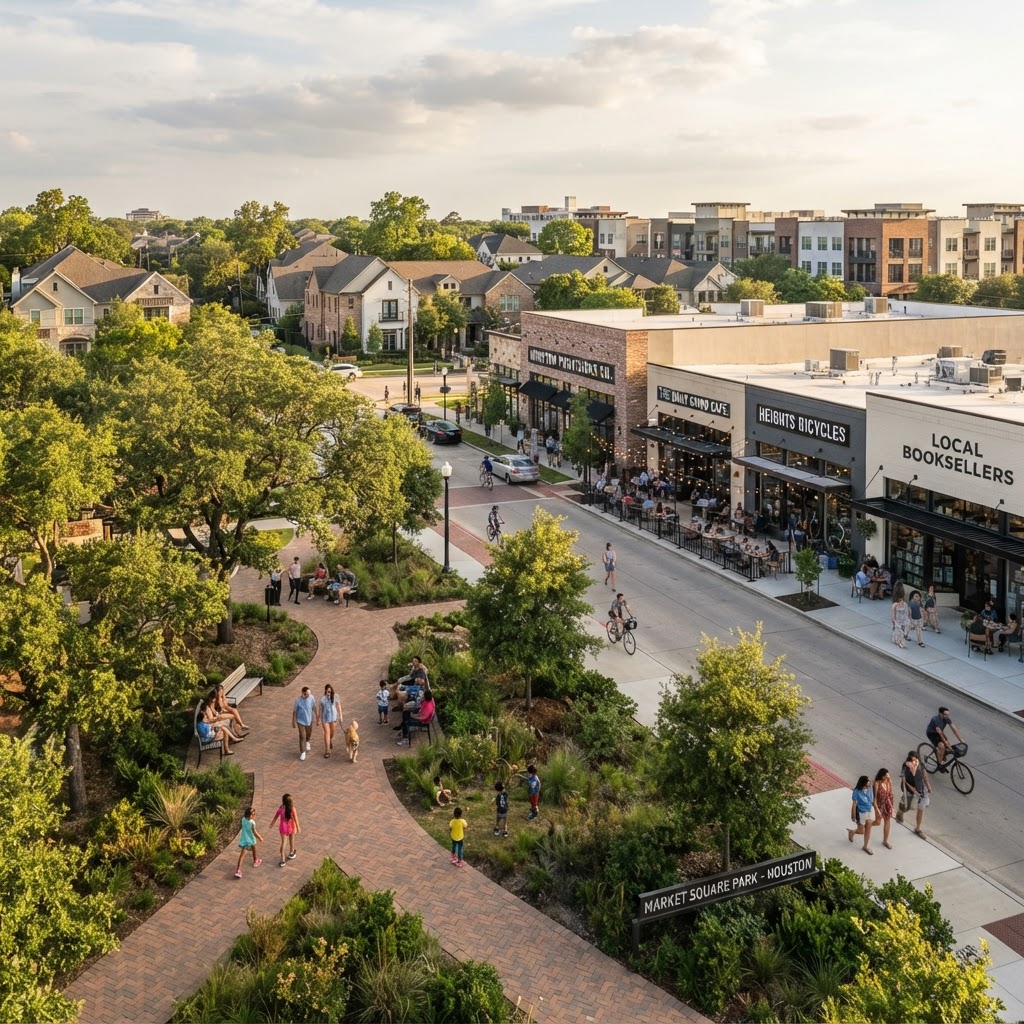
For decades, the narrative of Houston real estate was defined by the open road. As a city that grew exponentially during the rise of the personal automobile, our urban fabric was woven together by vast freeway networks and sprawling residential grids. However, as we navigate the current landscape of 2026, the preferences of Houston’s most discerning buyers have shifted. The modern professional and the growing family no longer define luxury by the size of a driveway alone, but by the ability to step out of their front door and into a vibrant, pedestrian-friendly environment.
This is the era of the walkable suburb. Houston has undergone a silent, structural transformation, shifting from a collection of isolated bedroom communities toward a network of dense, mixed-use hubs that marry the convenience of the city with the serenity of the suburbs. Whether you are eyeing a classic home in West University Place or a modern residence near the Woodlands Waterway, the value of proximity has never been higher. At Chambers Properties Group, we believe understanding this shift is the key to making an informed investment in today’s complex market.
The Walkability Shift: Redefining the Houston Standard
The pivot toward pedestrian-friendly living is not merely a lifestyle preference. It is a fundamental change in how the city manages density and growth. Throughout 2026, we have observed significant infrastructure investments that prioritize the human scale over the vehicle scale. Street-level improvements, wider sidewalks, and the integration of bikeable infrastructure have turned previously car-dependent neighborhoods into thriving, active communities. This trend is particularly evident as Houstonians seek to reclaim the hours once lost to daily commuting.
Data from the first half of 2026 indicates that properties within a five minute walk of integrated retail hubs are experiencing a 12 percent higher appreciation rate compared to homes located in strictly residential zones. Inventory levels in these highly walkable pockets remain remarkably tight, often hovering around 1.8 months of supply, compared to the city-wide average of 3.5 months. For the buyer, this means that competition is fierce. With a median price point of 950,000 dollars in premium walkable zones, properties are moving quickly, often spending just 24 days on market before receiving multiple offers.
This shift is rooted in the demand for convenience. High-net-worth individuals are prioritizing neighborhoods where coffee shops, boutique fitness studios, and gourmet grocers are within arm’s reach. The psychological and physical benefits of a walkable life have shifted these areas from niche markets to the premier tier of Houston real estate. As we look at the broader map, the transition is visible from the core of Montrose and The Heights out to the refined corridors of Memorial and beyond. You can Explore Houston neighborhoods to see how these transitions are reshaping specific zip codes.
Top-Tier Walkable Districts: The Premium Hubs
When we discuss the pinnacle of walkable suburban living, three distinct areas consistently command the attention of our advisory practice: Sugar Land Town Square, CityCentre, and The Woodlands Waterway. These districts represent the gold standard of mixed-use development, where the lines between residential, commercial, and recreational space are effectively erased. They are not simply shopping centers. They are the hearts of their respective communities, designed to host everything from seasonal markets to high-end dining experiences.
Sugar Land Town Square has successfully bridged the gap between traditional suburban life and urban energy. Its walkability factor has propelled property values in the immediate vicinity to a median price of 875,000 dollars. The integration of luxury residential units directly adjacent to corporate office space has created a self-sustaining ecosystem that attracts executives who value time above all else. Similarly, CityCentre continues to act as a magnet for professionals who appreciate the convenience of having boutique retail and fine dining mere steps from their front door.
In the north, The Woodlands Waterway remains a benchmark for master-planned excellence. The intentional design, which prioritizes waterfront promenades and dense forest canopy alongside retail infrastructure, has kept demand consistently high. With days on market averaging just 22 days for premium homes in this sector, it is clear that buyers are willing to pay a premium for the lifestyle these hubs offer. The success of these areas proves that when developers focus on the pedestrian experience, they create lasting value that is largely insulated from the broader market volatility. If you are looking to position your portfolio for long-term growth, Start your home search in these high-velocity districts.
The Economic Premium of Pedestrian-Friendly Real Estate
In real estate, location has always been the primary driver of value. Today, however, the definition of location has evolved to focus on walkability. Our analysis at Chambers Properties Group shows that pedestrian-friendly real estate provides a significant hedge against market fluctuations. Proximity to amenities is a permanent value add. While interior finishes and trends change, the convenience of a five-minute walk to a high-quality neighborhood center is an asset that appreciates steadily over time.
Investors and homeowners should consider the economic premium associated with these locations. Currently, properties in walkable neighborhoods are seeing a year-over-year value increase of 7 percent, outperforming the broader Houston market. This is driven by limited inventory and a lack of land for new, dense developments. In historic areas like West University Place and Bellaire, where land is scarce and the grid is already established, the premium for walkability is baked into the price. Even in a fluctuating interest rate environment, these homes remain the most resilient assets in our portfolio.
We advise our clients to view walkability as an infrastructure investment. Just as a new highway or school can boost property values, the development of a local town square or a protected bike path creates a permanent increase in desirability. When you purchase in these areas, you are not just buying a house. You are buying into a community that is architecturally and socially designed to maintain its relevance for decades to come. The economic reality is simple, as high-net-worth buyers increasingly trade size for location, the scarcity of high-quality, walkable homes will continue to push prices upward.
Lifestyle Amenities Beyond the Walk
Modern affluent buyers are looking for more than just a sidewalk. They are looking for a complete lifestyle ecosystem. The most successful master-planned developments in Houston are now integrating boutique wellness centers, private coworking spaces, and expansive green belts that feel more like nature preserves than urban parks. This holistic approach to development is what separates the neighborhoods of tomorrow from the tired suburbs of yesterday.
Green space is no longer an afterthought. It is a core component of the property value calculation. We are seeing a distinct trend toward wellness-centric architecture, where homes are designed to facilitate an active, healthy life. This includes features like dedicated home gyms, air-purification systems, and seamless access to local parks where community programming is constant. In neighborhoods like River Oaks or the surrounding pockets of Memorial, the focus has shifted toward privacy, peace, and proximity to nature, even while being nestled within the urban core.
These amenities serve as a bridge between the hustle of professional life and the necessity of relaxation. When a community offers a wellness center as part of its master plan, it reduces the need for the resident to travel elsewhere for their daily routines. This contributes to the overall sense of ease and quality of life that defines the modern, high-end Houston experience. Our advisory approach at Chambers Properties Group involves evaluating these hidden assets, ensuring that our clients are investing in neighborhoods that offer a comprehensive, premium lifestyle rather than just a roof over their heads.
Future-Proofing Your Location: Identifying Emerging Hubs
Strategic buyers in 2026 are already looking beyond the obvious hotspots to identify the next wave of walkable-capable neighborhoods. These are areas currently undergoing zoning shifts, infrastructure upgrades, or retail revitalization that will eventually lead to the same premium status as CityCentre or The Heights. Identifying these areas requires a deep understanding of municipal planning, developer activity, and long-term population shifts.
One of the best ways to future-proof your investment is to look for neighborhoods that have a high density of mid-century residential lots located near established, yet under-developed, commercial corridors. We look for areas where the city is actively investing in drainage and street-scape improvements. When the infrastructure is upgraded, it signals that the city is ready for higher density and increased foot traffic. These neighborhoods are currently priced more competitively, often at a median price point of 650,000 dollars, providing a unique opportunity for early entry.
For those willing to play the long game, these areas offer the highest potential for total return on investment. The key is to avoid neighborhoods that are completely finished, as the appreciation has likely already been realized. Instead, focus on the "pioneer" stage of redevelopment. This is where Chambers Properties Group adds the most value, as we monitor municipal development permits and retail lease activity to identify these burgeoning clusters before the rest of the market catches on. If you want to discuss which neighborhoods are positioned for growth over the next five to ten years, Book a strategy call with our team.
CPG Advisory Approach: Securing Your Future
At Chambers Properties Group, we believe that real estate is the foundation of wealth, and that foundation must be built on data-driven strategy. The Houston market is far too large and complex to navigate with general assumptions. Our practice is built on providing granular, neighborhood-specific insights that allow our clients to make decisions with confidence. We do not just show homes; we analyze market velocity, inventory supply trends, and zoning shifts to ensure that every property we recommend aligns with your long-term goals.
Our approach begins with a comprehensive audit of your lifestyle needs. We understand that for a professional or a family, the decision to buy is as much about how you will live as it is about the asset itself. By leveraging our deep relationships within the brokerage community and our understanding of upcoming residential projects, we provide our clients with access to opportunities that are often off-market or in the pre-listing phase. This is how we ensure that you are not just keeping pace with the market, but staying ahead of it.
Whether you are looking to relocate to a bustling district like The Heights or secure a quiet, high-value property in West University Place, our team is committed to your success. We handle the complexities of negotiation, due diligence, and market analysis so that you can focus on the vision for your life. We are proud to serve the Houston market with a focus on transparency, integrity, and absolute expertise.
Ready to talk strategy? Book your free consultation or get your instant home valuation.
Listen on the Go
The Chambers Review Podcast
This week: The Resurgence of Adaptive Reuse: Transforming Houston’s Aging Industrial Corridors into High-End Residential Enclaves
As Houston’s inner-loop land values reach historic highs, developers and sophisticated investors are pivoting from demolition to design,...
Listen to the Latest EpisodeExplore Houston Neighborhoods
Find your perfect neighborhood
By Nick Chambers, Broker Associate, Chambers Properties Group · Realty of America