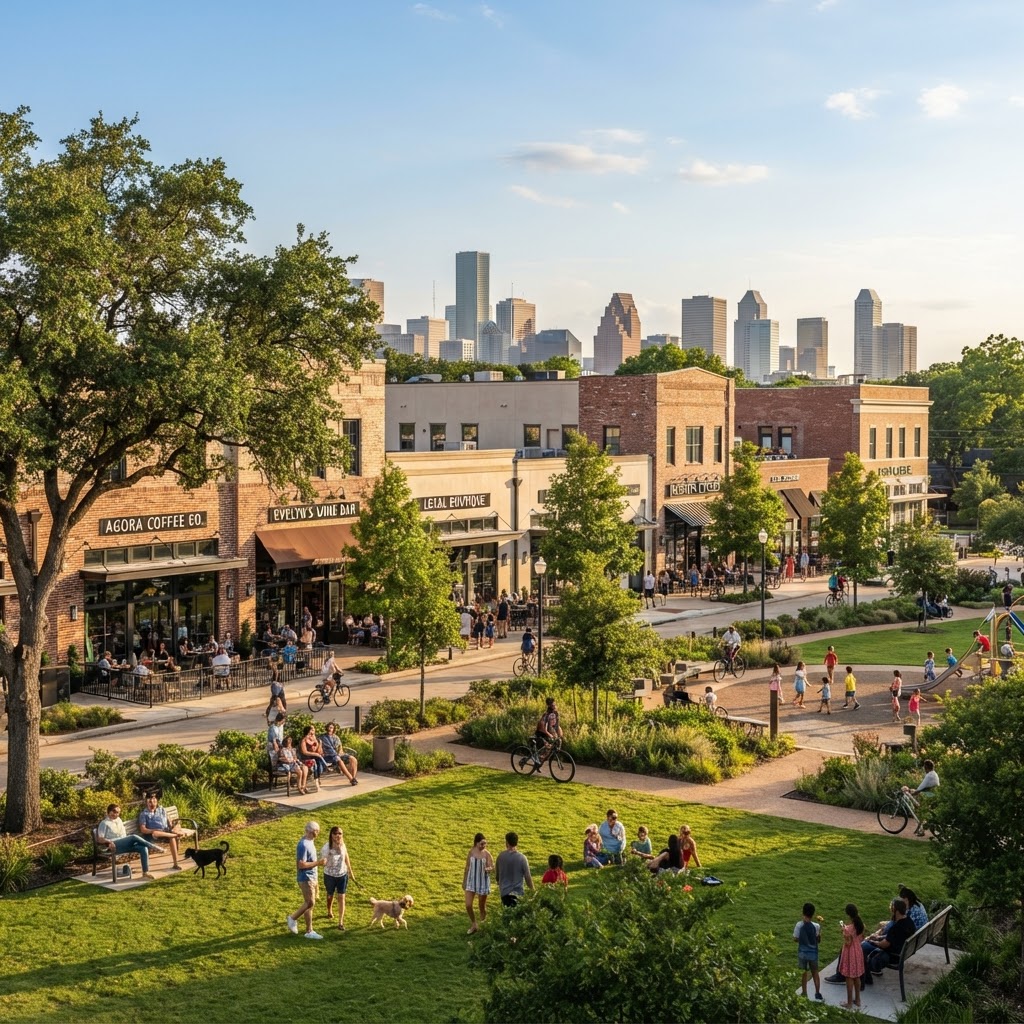
For decades, the Houston real estate narrative was defined by expansive sprawl and a singular reliance on the central business district. Today, that narrative has fundamentally shifted. As we look at the landscape of 2026, the traditional hub and spoke model of the city has been replaced by a polycentric web of high density micro hubs. These clusters, located primarily within the 610 Loop and its immediate periphery, are redefining what it means to live, work, and invest in the Bayou City. The days of the long, taxing commute are being eclipsed by the rise of the walkable, hyper connected neighborhood where the best of Houston is accessible within a fifteen minute radius.
At Chambers Properties Group, we have observed a definitive change in buyer behavior among our high net worth clients. Investors and homeowners are no longer just looking for a large lot or a specific school zone. They are seeking efficiency, cultural integration, and long term asset stability driven by proximity to boutique corporate campuses and local amenities. This transformation is not accidental. It is the result of strategic zoning evolution, significant infrastructure investment, and a cultural pivot toward high density, amenity rich urbanism. As we analyze the trajectory of 2026, it becomes clear that these micro hubs represent the next frontier of Houston real estate appreciation.
The Evolution of Urban Density and Zoning Shifts
The post 2024 landscape has been marked by a departure from strict residential segregation. Houston has leaned into its unique approach to development, favoring mixed use projects that bridge the gap between commercial vitality and residential comfort. In neighborhoods like Montrose and The Heights, we are seeing the conversion of legacy industrial and older commercial sites into boutique, high density residential clusters. This density does not sacrifice the character of these neighborhoods. Instead, it enhances it by providing the critical mass of residents needed to support a diverse ecosystem of luxury retail, independent fitness studios, and high end dining.
Current market data indicates that these high density pockets are outperforming the broader market. In these micro hubs, the median price for new construction townhomes and luxury condominiums now sits at approximately 875,000 dollars, reflecting a steady appreciation of 6 percent over the last twenty four months. Days on market for properties within these high demand clusters are currently averaging 38 days, significantly tighter than the broader Houston average of 55 days. These figures suggest that while the city at large remains balanced, these specific hubs are experiencing a supply constraint that drives competitive bidding and price stabilization. Investors should note that the shift toward vertical living is no longer a niche preference but a dominant trend supported by municipal planning initiatives that encourage walkability. You can Explore Houston neighborhoods to see which of these clusters align with your portfolio goals.
Economic Drivers of the Polycentric Model
The decentralization of Houston’s corporate footprint has been a primary catalyst for real estate demand. As satellite offices for energy, health care, and technology firms move into residential corridors, the demand for executive level housing within close range of these hubs has surged. We are witnessing the emergence of the 15 minute city model, where the barrier between home and the workplace is minimized. This is particularly evident in the zones surrounding the Memorial corridor and the burgeoning tech clusters on the edges of the inner loop.
This economic dispersion has created a unique value proposition. Properties in neighborhoods like Bellaire or near the West University Place boundary are increasingly coveted because they offer proximity to both the medical center and these new satellite professional hubs. By reducing the reliance on major highway arteries, these residential nodes offer a lifestyle quality that is highly attractive to busy professionals. Our analysis shows that properties within a two mile radius of emerging boutique corporate hubs command a price per square foot premium of 12 percent compared to similar properties located further away from these centers. This trend confirms that employment proximity remains the most reliable hedge against market volatility. For those looking to capitalize on these shifts, our advisory team can provide deeper insights. Book a strategy call with CPG to discuss your investment goals.
Infrastructure and Connectivity Gains
The physical transformation of Houston is perhaps best exemplified by the progress of the North Houston Highway Improvement Project and the systematic expansion of local greenway networks. These investments are more than just transit improvements. They are mechanisms for neighborhood stabilization. The connectivity provided by these projects allows for a more fluid movement of residents between districts, which in turn encourages local commerce and increases property velocity. When a neighborhood gains better access to a central hub or a regional greenway, the liquidity of that real estate market typically increases.
Localized infrastructure investments, such as improved pedestrian corridors and bike accessibility, have proven to be significant indicators of future value growth. Neighborhoods that have successfully integrated these elements, such as the areas bordering the Heights and those near Buffalo Bayou, have seen their inventory levels remain consistently low at 2.4 months. This limited supply, coupled with steady demand from high net worth buyers, creates a robust environment for long term appreciation. We monitor these physical improvements closely, as they are often the leading indicators of where developers will break ground next. Strategic acquisition in these areas requires a forward thinking approach, one that looks past current construction noise to the eventual utility of the completed infrastructure.
Lifestyle Amenities and Cultural Anchors
Luxury retail encroachment and the migration of culinary talent are no longer confined to the traditional districts of River Oaks or West University Place. We are seeing a decentralization of lifestyle amenities, where artistic hubs and boutique fitness studios act as the new anchors for residential value. In 2026, a neighborhood is judged not just by its square footage, but by the density and quality of its cultural and recreational outlets. This retail and lifestyle migration creates a self reinforcing cycle of demand.
As high end amenities move into an area, the demographic profile shifts, further attracting high net worth individuals who prioritize convenience and experience. In our current data, neighborhoods that have recently added a major "lifestyle anchor" have seen a 7 percent increase in median property values within an eighteen month window. This phenomenon is a direct response to the desire for curated living. Residents are willing to pay a premium for neighborhoods where they can walk to a Michelin starred restaurant or a private wellness club. This is the new gold standard for Houston real estate, and it is reshaping the competition for inventory in the most desirable residential pockets. We encourage you to Start your home search to view current listings in these amenity rich neighborhoods.
Predictive Neighborhood Appreciation
At Chambers Properties Group, we utilize a proprietary model to track the disparity between established nodes and emerging micro hubs. By analyzing the price per square foot gap between a premier neighborhood like River Oaks and its emerging neighbors, we can identify windows of opportunity where the value discrepancy is unjustified by the neighborhood's fundamentals. Currently, we have identified three emerging micro hubs where the current entry point is undervalued by approximately 15 to 20 percent compared to the historical trendlines of more mature sectors.
The strategy here is not to time the market perfectly, but to identify neighborhoods that are in the middle of their maturation cycle. When we look at these emerging nodes, we examine the ratio of renovation activity to new construction, the influx of commercial leases, and the density of local foot traffic. These metrics provide a clearer picture of future value than simple price history. Investors who move into these areas while the price per square foot remains below the 450 dollar threshold are often well positioned to benefit from the eventual "premium" pricing that accompanies full maturity. It is a calculated risk, but one that is mitigated by the structural shift toward inner loop density.
Strategic Acquisition and Risk Mitigation
Acquiring property in a rapidly changing urban environment requires a high level of due diligence. When evaluating assets in emerging micro hubs, we focus on the "floor" of the property’s value. This involves assessing the quality of the land, the long term viability of the zoning, and the strength of the surrounding residential fabric. We advise clients to look for properties that offer versatility, such as homes that can be renovated to accommodate modern luxury expectations or land parcels that allow for future redevelopment.
Risk mitigation in this context involves avoiding the "hype cycle" and focusing on fundamental demand drivers. We prioritize properties that are within walking distance of existing transit or greenway projects, and those that are located in neighborhoods with strong, resident led neighborhood associations. These associations are vital for preserving the character of the neighborhood while managing the challenges of increased density. By focusing on these factors, buyers can secure assets that provide both personal lifestyle utility and long term wealth appreciation. The goal is to move beyond short term market fluctuations and focus on the structural, long term growth of Houston’s most vibrant districts.
Ready to talk strategy? Book your free consultation or get your instant home valuation.
Listen on the Go
The Chambers Review Podcast
This week: The Resurgence of Adaptive Reuse: Transforming Houston’s Aging Industrial Corridors into High-End Residential Enclaves
As Houston’s inner-loop land values reach historic highs, developers and sophisticated investors are pivoting from demolition to design,...
Listen to the Latest EpisodeExplore Houston Neighborhoods
Find your perfect neighborhood
By Nick Chambers, Broker Associate, Chambers Properties Group · Realty of America