Under editorial review. This page is kept for the record and is not shown in the library, and its claims are not presented as current guidance until a person reviews them.

Houston’s Inner Loop 2026: The Rise of Walkable Micro-Markets
The Chambers Review
Neighborhoods

Houston’s Inner Loop 2026: The Rise of Walkable Micro-Markets

Discover why 2026 is the pivotal year for Houston's Inner Loop as demand shifts toward hyper-walkable micro-markets and lifestyle-integrated urban housing.

August 9, 202611 min read

For decades, the Houston narrative was defined by the automobile. Our city was a sprawling tapestry of six lane arterials, master planned suburban enclaves, and a "drive until you qualify" culture that stretched the map toward the far flung reaches of Katy and The Woodlands.

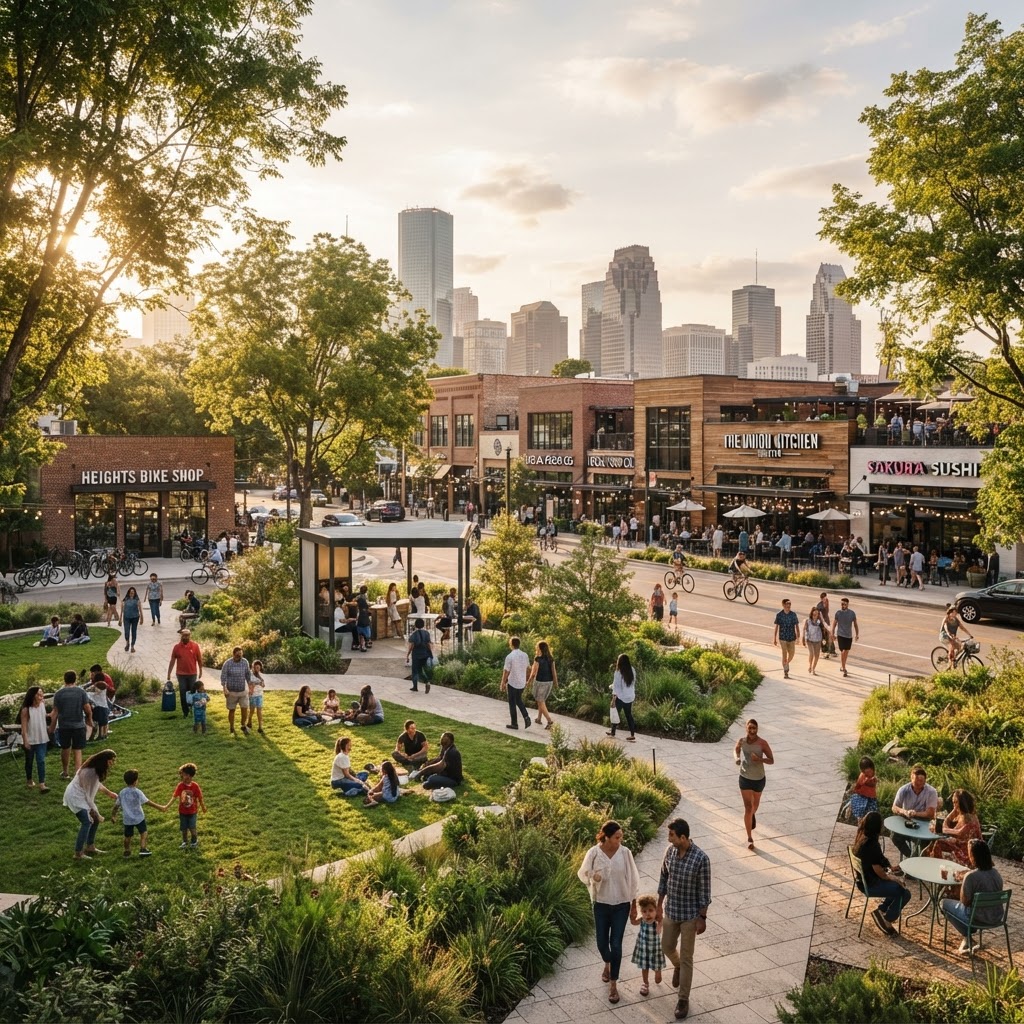
Yet, as we stand in the early months of 2026, the skyline isn't the only thing changing. A fundamental shift is rippling through the 610 Loop, moving away from the suburban sprawl model toward the "15 minute city" concept.

In the Inner Loop, the premium is no longer tied strictly to square footage or the size of a backyard. Instead, it is being defined by the radius of a walkable lifestyle. As a practice, Chambers Properties Group has observed a marked pivot in buyer behavior.

Our clients are no longer asking how close a property is to the I-10 or 610 interchange. They are asking how many coffee shops, green spaces, and neighborhood markets sit within a five minute stroll of their front door. This transition to high density, pedestrian centric nodes is redefining what it means to live in Houston.

The Evolution of Density: From Sprawl to Pedestrian Corridors

For years, Houston’s development patterns were horizontal. Today, the geography of wealth is turning vertical and hyper-localized. Inside the Loop, we are seeing the fragmentation of traditional neighborhoods into distinct, walkable micro-markets.

In The Heights, for example, the focus has shifted from the preservation of large lot inventory to the tactical densification of corridors like 11th and 19th Streets. These zones are no longer just commercial strips. They are the heartbeats of the community, where luxury townhomes and boutique multi-family developments are being designed specifically to cater to those who value the "leave the car at home" lifestyle.

$745,000Inner Loop Median Price
42Average Days on Market
2.8 MonthsInventory Supply
12% to 15%Node Appreciation Premium

This shift is rooted in a fundamental desire for social integration. Modern buyers seek neighborhoods that function as ecosystems. They want a seamless transition between a professional workspace, a gym, and a bistro. In West University Place and Bellaire, we are seeing this expressed through the thoughtful integration of pocket parks and pedestrian pathways.

By prioritizing the human scale over the mechanical scale, these neighborhoods have insulated themselves from the volatility often associated with suburban sprawl, creating a stable environment for Houston’s Inner Loop expansion.

DOM
Days on Market. A measure of the time it takes for a property to sell, reflecting the velocity and demand of a specific micro-market.
High-density vertical development is reshaping the Inner Loop skyline as Houston shifts toward hyper-localized walkable nodes.

Zoning and Infrastructure: The Mechanics of Urban Accessibility

Houston’s lack of traditional zoning has historically been a double edged sword. However, in 2026, municipal initiatives and private sector investment have coalesced around mixed use accessibility.

In areas like Montrose, the city’s proactive investment in streetscape improvements, including wider sidewalks and traffic calming measures, has turned formerly car heavy arteries into pedestrian friendly conduits. This is an infrastructure backed strategy to boost property values through enhanced access, directly impacting Houston’s infrastructure pulse.

In River Oaks and the surrounding areas, this evolution is taking the form of "planned permeability." Developers are increasingly incentivized to build in ways that allow residents to navigate their daily needs without navigating a highway. When you analyze municipal permits, there is a clear trend. Mixed use projects that include ground floor retail beneath residential units are being fast tracked, indicating that the City of Houston is effectively nudging developers toward the very density that long term investors crave.

The Walkability Premium: Quantifying Value

How much is a walk to your local bistro actually worth? In real estate terms, the "Walkability Premium" is no longer an abstract concept. It is a measurable data point.

Our analysis at Chambers Properties Group reveals that homes located within a five minute walk of core retail and dining centers command, on average, an $85,000 to $120,000 premium over identical properties just one mile away. This is a calculated investment in time efficiency and asset liquidity.

Walking Radius Value Premium

Within 5-Minute WalkWithin 10-Minute WalkOutside Walkable Node01234

Furthermore, the data shows that these walkable micro-markets are more resilient during market corrections. While the broader Houston market experienced minor price softening in 2026, homes in highly walkable pockets saw an appreciation rate of 4.2% year over year. The demand is driven by high net worth professionals who are prioritizing quality of life over square footage. They recognize that they are buying into the walkability dividend that is increasingly scarce.

Key Takeaway
The strategic priority for 2026 buyers is no longer just "location, location, location," but rather "connection, connectivity, and access."

Adaptive Reuse: Breathing New Life into Urban Assets

One of the most compelling trends we are tracking is the rise of adaptive reuse in the Inner Loop. Houston is fortunate to have a rich architectural history, and today’s developers are retrofitting older, underutilized commercial buildings.

In neighborhoods bordering Montrose and the East End, these redevelopments are preserving historic character while upgrading quality to meet the stringent demands of 2026 buyers. This "adaptive density" allows for a unique aesthetic that cannot be replicated in suburban subdivisions.

For the investor, this offers an opportunity to buy into a property with a distinct identity, which is a strong driver for transforming industrial corridors. Adaptive reuse also mitigates risks. By utilizing existing foundations and infrastructure, these projects often reach completion faster with less regulatory friction.

"Our clients are no longer asking how close a property is to the interchange; they are asking how many coffee shops and neighborhood markets sit within a five-minute stroll of their front door." — Nick Chambers

Future-Proofing Real Estate: Resilience in a Changing Climate

"Future proofing" in Houston requires a multi faceted approach. It’s not just about economic trends. It’s about environmental and logistical resilience. By concentrating living and working environments into dense nodes, we are designing a city that is more robust against traffic congestion and industrial logistics pressures.

Many of our clients are specifically targeting neighborhoods with elevated topography and modernized storm water management systems, such as parts of Memorial and West University Place. These areas have benefited from recent municipal drainage improvements and are becoming the "safe havens" for long term residential investment.

The integration of green spaces into these dense nodes is also critical. Neighborhoods that prioritize parks and pedestrian trails, like the Buffalo Bayou expansion near River Oaks, are seeing higher demand. The presence of nature within an urban setting is becoming a luxury commodity.

Strategic residential investments are increasingly focused on neighborhoods that blend modern storm-water management with integrated green spaces.

Investment Strategy: Identifying the Next 'Emerging' Pockets

Identifying the next 'emerging' walkable pocket before the rest of the market catches on is the hallmark of a successful Houston real estate strategy. While the established neighborhoods like River Oaks remain gold standard investments, the savvy investor is currently looking toward the peripheries.

These "transition zones" are neighborhoods where hyper-local growth is in its nascent stage. The key to identifying these pockets is to follow the capital. Look for areas where new, high end independent coffee shops, wellness studios, and boutique grocers are popping up.

These businesses are excellent barometers for future property value appreciation. By identifying these corridors before large scale luxury residential developments arrive, investors can secure entry points at a more attractive price to value ratio, often by mastering the off-market market.

Conclusion: The Path Forward

The Houston of 2026 is a city of distinct, interconnected worlds. The shift toward walkable micro-markets is the most significant development in our local real estate market. For the high net worth buyer or the strategic investor, the message is clear. The most valuable real estate in Houston is now the real estate that connects you to your life.

Whether you are seeking a primary residence that offers the ease of city living or an investment portfolio designed for long term appreciation, the principles remain the same. Prioritize walkability, look for infrastructure backed density, and focus on the nodes that offer the highest level of resilience and connectivity. The "15 minute city" isn't just a vision for the future. It is the present reality of Houston's most successful neighborhoods.

Ready to talk strategy? Book your free consultation or get your instant home valuation.

Explore Houston Neighborhoods

Find your perfect neighborhood

***

By Nick Chambers, Broker Associate, Chambers Properties Group · Realty of America

Have a question about this?

Nick answers these himself, usually the same day. No obligation, and nothing is sold to you.

A request, not an agreement. Email only; no marketing unless you ask for it.

Have a Question?

Talk to Nick directly.

Every article is grounded in real Houston market data. A 20-minute call with Nick gives you the same analysis, tailored to your situation.