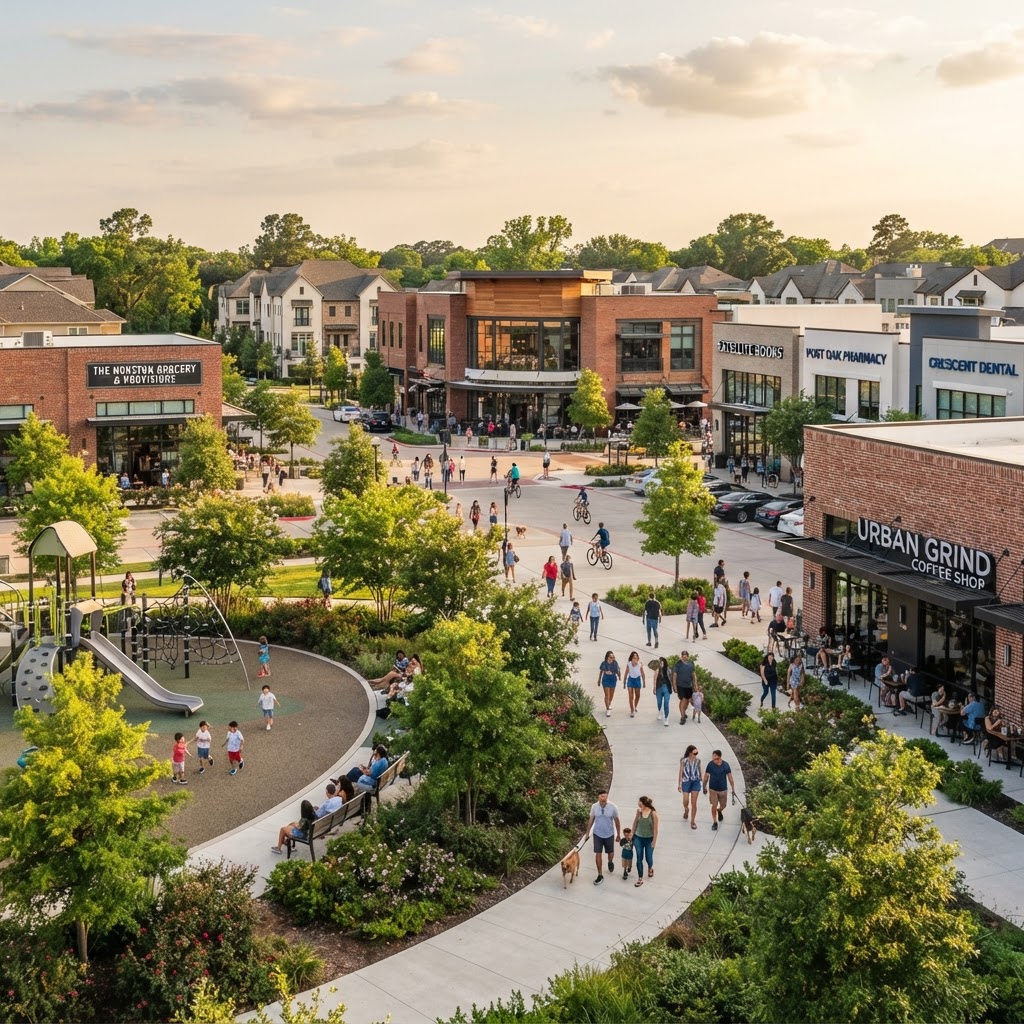
The Houston landscape is undergoing a fundamental transformation that is reshaping how we define the heart of the city. For decades, the professional core of Houston was anchored firmly within the Inner Loop. Neighborhoods like West University Place, Bellaire, and River Oaks served as the undisputed gold standard for those who demanded proximity to the Energy Corridor, the Texas Medical Center, and the downtown financial district. Today, that gravity is shifting. We are observing a calculated migration toward satellite hubs, where the convergence of infrastructure, corporate investment, and lifestyle amenities is creating a new blueprint for suburban luxury.
As we look toward the 2026 real estate cycle, the traditional metrics of urban convenience are being challenged by the rise of self-sustaining suburban nodes. The transition is not merely a preference for more space, but a strategic realignment toward environments that offer professional functionality without the friction of a sixty minute commute. This shift is redefining what it means to be well connected in the Greater Houston area. Whether you are a high net worth professional looking to optimize your lifestyle or an investor seeking long term stability, understanding this geographic evolution is the most critical step in your real estate journey. You can Explore Houston neighborhoods to see how these transitions are reflected in current inventory.
The Decentralization Trend and the New Suburban Model
The modern professional no longer requires a physical desk in the central business district to be effective. This pivot to hybrid work models has acted as a primary catalyst for the decentralization of Houston. Where we once saw a singular focus on proximity to skyscrapers, we now see a demand for infrastructure that supports remote productivity and satellite office integration. Katy and Fulshear have become the focal points of this trend, transitioning from bedroom communities into primary destinations for executive level families. Similarly, the corridor stretching from The Woodlands toward Conroe is evolving into an autonomous economic zone.
These satellite hubs now feature secondary medical campuses and satellite offices for major engineering and energy firms. This decentralization does not imply a decline for the urban core, but rather a diversification of value. Neighborhoods like The Heights and Montrose continue to hold immense prestige for their culture and walkability, yet the satellite hubs are gaining market share by offering lower density and superior lifestyle programming. In 2026, the median sales price in the Katy Fulshear corridor has climbed to approximately 645,000 dollars, with days on market averaging 38 days. This reflects a tightening of supply as high net worth individuals seek out homes that serve as both a sanctuary and a functional workplace.
Quality of Life as a Real Estate Anchor
Desirability in the current Houston market is measured by a new set of benchmarks. School district performance remains a perennial driver, but it is now paired with a demand for green space and third place town centers. These are environments that exist outside of the home and the office, such as high end retail plazas, boutique wellness centers, and curated outdoor amphitheaters. These spaces replicate the urban density of River Oaks or Memorial within a suburban frame, providing the social connectivity of the city without the traffic congestion.
The most successful developments are those that integrate nature into the built environment. We are seeing a premium placed on master planned communities that feature extensive trail systems and protected greenspaces. This shift is a direct response to the demographic demand for wellness oriented living. Investors should note that homes situated within walking distance of these regional town centers are consistently outperforming the broader market in terms of appreciation. By prioritizing connectivity to parks and social infrastructure, these areas have created a defensive moat around property values. Whether you are ready to relocate or are assessing your portfolio, you can Book a strategy call to discuss how these quality of life metrics impact your specific investment goals.
Connectivity and Infrastructure as Value Drivers
The expansion of the Grand Parkway, known as State Highway 99, remains the most significant infrastructure influence on Houston real estate. The completion of this loop has effectively unlocked vast tracts of land, turning previously peripheral zones into highly accessible hubs. As the road network matures, the ripple effect on property values is profound. Areas that were once considered isolated are now within a thirty minute drive of multiple employment nodes. Furthermore, upcoming light rail and rapid transit studies indicate that municipal planners are preparing for a density shift that will further link these satellites to the regional grid.
In 2026, we see inventory levels in these key expansion zones hovering at a slim 2.8 months, indicating a strong sellers market. This scarcity is exacerbated by the pace of infrastructure development, which consistently outstrips the pace of new residential construction. When analyzing potential properties, we focus heavily on proximity to these major transit arteries. Connectivity is the ultimate hedge against market volatility. While the city center remains the cultural pulse, the ability to bypass major bottlenecks via an outer loop is increasingly viewed as a luxury that justifies a higher price point per square foot.
Economic Anchors and Micro Economies
One of the most compelling aspects of the 2026 market is the emergence of self sustaining micro economies. We are no longer dealing with simple residential sprawl. Instead, we see the strategic placement of major corporate campuses into the suburban periphery. When a large firm moves its regional headquarters to a satellite hub, it creates a gravitational pull for auxiliary businesses, high end services, and professional talent. This ecosystem insulates the local real estate market from the boom and bust cycles that often plague singular, industry dependent downtowns.
These micro economies are creating a robust rental demand, attracting high earning professionals who prefer to rent luxury single family homes while they evaluate their long term residential options. For the strategic investor, this represents a unique window to enter the market. Cap rates for premium suburban properties in high growth nodes are currently stabilizing at 5.2 percent to 6.8 percent, providing a compelling alternative to more traditional, lower yield urban investments. The resilience of these hubs is bolstered by the presence of anchor institutions that ensure steady occupancy and consistent interest from institutional buyers.
Investment Profile of Satellite Hubs
The transition of satellite hubs from temporary suburban enclaves to permanent investment vehicles is a defining feature of this decade. Investors are finding that the risk profile in these areas has evolved. Because these communities are becoming increasingly autonomous, the investment thesis has shifted from speculative land plays to stable, income generating assets. The modern Houston investor looks for properties that offer a balance of aesthetic appeal and functional utility for the remote professional.
When evaluating these neighborhoods, we prioritize properties that can adapt to changing demographic needs. This includes features like flex rooms for home offices, multi generational floor plans, and high efficiency home systems. The data shows that homes meeting these criteria command a premium and experience shorter turnover times. If you are looking to diversify your portfolio, you can Start your home search with a focus on these high growth satellite corridors. Understanding the local nuances of each sub market is essential to maximizing your long term return on investment and protecting your capital against regional market adjustments.
Future Proofing Your Move
Selecting a home today requires a strategic framework that looks beyond the present moment. Future proofing a move to a satellite hub involves an analysis of municipal planning data, demographic projections, and the long term trajectory of the local school system. It is not enough to look at what a neighborhood offers now. One must assess what that neighborhood will look like in seven to ten years. Demographic shifts are leading to a more diverse and professional population in these outer reaches, which in turn leads to increased funding for public amenities and higher appreciation rates.
We advise our clients to look for signs of planned infrastructure improvements. Is there an expansion of a major hospital system? Is there a new retail development anchored by high end grocers? These are the indicators of a mature, self sustaining neighborhood that will hold its value throughout the next decade. As you evaluate your options, keep in mind that the best investments often require a balanced perspective on both current lifestyle needs and long term resale potential. Our advisory practice is dedicated to providing the data and insights necessary to navigate these complex decisions with confidence.
Ready to talk strategy? Book your free consultation or get your instant home valuation.
Listen on the Go
The Chambers Review Podcast
This week: The Resurgence of Adaptive Reuse: Transforming Houston’s Aging Industrial Corridors into High-End Residential Enclaves
As Houston’s inner-loop land values reach historic highs, developers and sophisticated investors are pivoting from demolition to design,...
Listen to the Latest EpisodeExplore Houston Neighborhoods
Find your perfect neighborhood
By Nick Chambers, Broker Associate, Chambers Properties Group · Realty of America